

“There’s always concern. There’s always concern.” When asked about his feelings towards media pressure following his Venice Biennale selection, Lebanese-born artist Khaled Sabsabi repeated this phrase twice, a heavy pause following each response. In what should have been a moment of extreme pride and excitement for the muslim artist, Sabsabi instead sat in reflection, and the product of his thought was tentative, to simplify.
Even though, on the days between February 7th and February 13th, Sabsabi had no reason to question the longevity of his tenure, there was a feeling of probation coating his words, a sense that his recognition as an artist of colour was temporary at best, conditional at worst.
On February 7th, Creative Australia (CA) announced the Western Sydney based artist as Australia’s 43rd representative of the nation at the Venice Biennale in 2026, one of the world’s most prominent cultural events. This selection from the government’s arts advisory body was of salience, coming after First Nations artist Archie Moore was awarded the Golden Lion in the 2024 exhibition. Eyes were locked on our country’s next move as prior victor, and yet what could have been a moment of defining breakthrough became an instance of embarrassing break bad, with authorities slipping – and violently lashing – in centerstage.
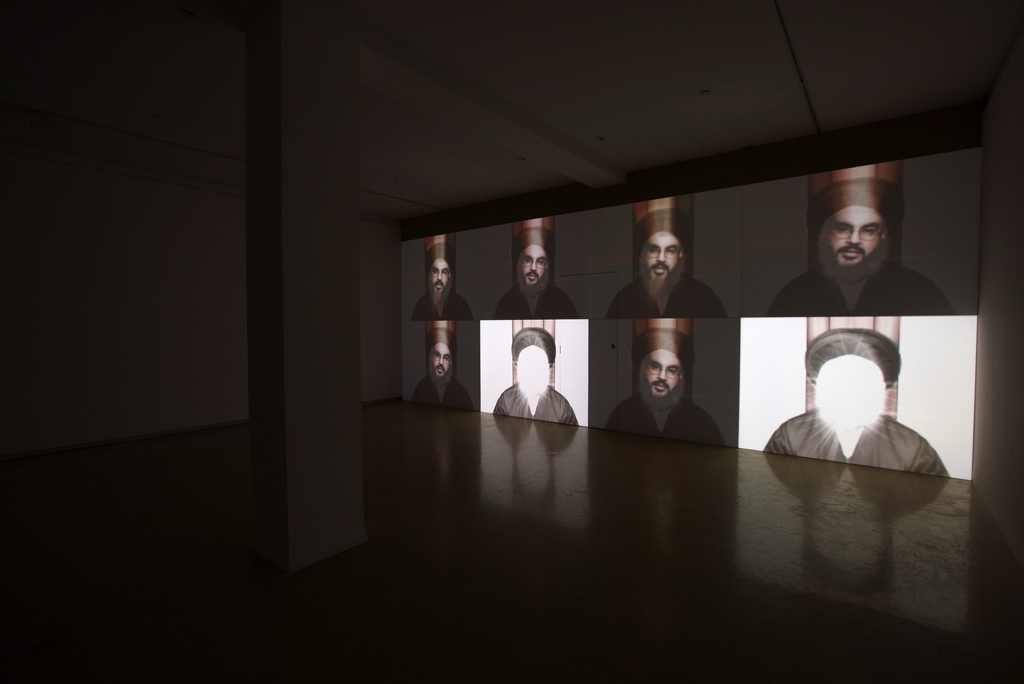
You by Khaled Sabsabi, Source: MCA Australia
When challenged in the Senate by Shadow Arts Minister Claire Chandler, Foreign Minister Penny Wong seemed caught off guard by the Opposition’s loud rejection of the board’s selection. Chandler suggested a glorification of Hezbollah leader, with a 2007 work titled ‘You’ portraying Nasrallah with golden light surrounding his head; it was this skepticism which would lead to the later revision, and ultimate rejection, of CA’s selection. ‘You’ was exhibited in UNSW’s 2007 exhibition, ‘The Resilient Landscape’, and was featured amidst a gallery of other confrontational works. The piece is intentionally ambiguous – as most art tends towards – with messaging of the media’s ability to deify or vilify anyone under the cornering of language being a heavy undertone. One could suggest the need for a mirror in the Senate, though that would feel somewhat nostalgic.
In a written statement released after CA abandoned Sabsabi, Chandler stated: “It’s right that Khaled Sabsabi will no longer be going on a taxpayer funded trip representing our country… Does the Minister agree with the weak cop-out of a statement issued by Creative Australia which claims that Mr Sabsabi’s appointment has only been reversed to avoid a ‘divisive debate’?” Once again, we see a politician demeaning an artist, exchanging Sabsabi’s motive to represent the experience of displaced artists of colour with a pursuit of a free holiday. Out of touch, yes, but not quite out of the ordinary. As for CA’s role in this, it seems antithetical that a body created to amplify the arts would weaponise the very value of the industry against itself. A question of integrity is invoked, but also a question of voice: who has it, and who can take it away.
As a member of the Lebanese diaspora, Khaled Sabsabi symbolises the voice of the minority in Australia. His works mirror the narratives of citizens removed by civil war, violently forced onto new land. Sabsabi is also tied by blood to Palestine; he stands for self-determination and a return to one’s motherland. In the days before his position was revoked, Sabsabi sat with journalist Nour Haydar to discuss his future as Australia’s representative. “I have applied four times, I felt that in this time and in this place, that this wouldn’t happen… We live in a society that still regards all muslims as terrorists,” Sabsabi stated. It would seem as though space is held for minority artists until a certain place on the moral binary is reached, and then space is, well… dropped.
It came as no surprise to see the spate of resignations from CA board members and ambassadors in the days following the revocation of Sabsabi and curator Degastino; if Creative Australia is the hand that feeds artists, it is now very bitten and very bloody. Dr. Tim Gregory, lecturer at the UNSW School of Art & Design, and peer of Sabsabi, states in response to the drop, “I think it is indicative of a broader shift towards a re-emergence of censorship in the arts. If, as Rancière writes, the divide in the world is between those who do, and those who do not have the ability to play with words and images, then censorship is one of the forms of policing that enforces and defines that divide.”
When a board intent on spotlighting artists’ voices turns around and silences them, it leaves a metallic taste in the mouth of those capable of comprehending irony. Sabsabi’s removal doesn’t look like freedom. It doesn’t look like truth-telling. It looks like censorship. It looks like political impetus in a time of great cultural war. It looks like the reality that artistic independence remains contractual in our country.
It’s no debate that there is a war against truth happening around us; artists should be the custodians of that truth – not patrons, not politicians. Sabsabi narrates that we can’t be shielded from what’s happening across the globe, yet the constant bickering does just that. We have to stop arguing and start participating, else loudness will continue to erase truth. The way to peaceful co-existence can be found through empathy, and empathy is born of art.
From the cacophony that was the 2023 Australian Voice referendum to the competitive campaigning around the upcoming election: our nation rarely allows voice to exist. Thousands of artists have been raising their voices for years, yet the magnitude of dispute echoes with more greed than ever. Boards like CA welcome this noise, because it necessitates their funding as a platform for art. Yet that can’t be the end we settle for. Yes, art is being spoken about, but let us not forget to check who is doing the talking.
In what felt like a tiny spark of hope, a ray of reprieve shining into the room where Sabsabi sat with Haydar in the bleary eye of this storm, an intimate moment came between the two. As talk turned towards the possibilities of the Venice Biennale, Sabsabi leant closer, lifting his head and repeating a phrase, twice again, only this time with a hope in his voice. “I can’t wait,” he confides, almost boyish in his leaking enthusiasm. “I can’t wait.”
Sabsabi, and every other artist of colour, migrant, and minority in our country, must now keep waiting, staring numbly at a clock that’s starting to feel frozen in a rhythm of erasure. With no art put forward by Australia in the 2026 Venice Biennale, we are not just neglecting culture, we are neglecting peace. With or without Khaled Sabsabi present in the Australian pavilion, his absence still portrays the country’s art scene as it stands.
And it’s a portrait thicker than paint.